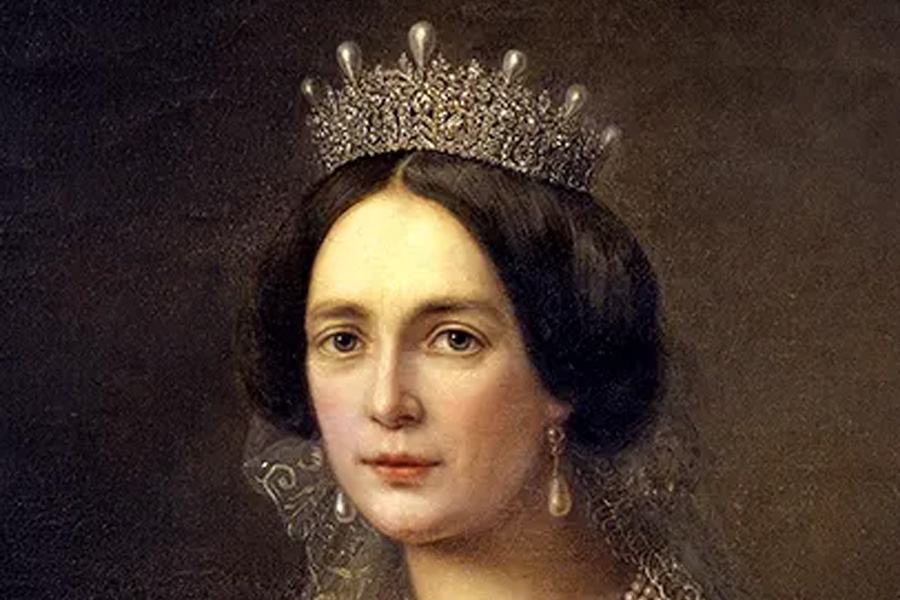
A royal life that began far from Sweden
It seems Josephine Of Leuchtenberg’s life blazed over Europe. She was born in Milan on March 14, 1807, when dynasties shook, borders altered, and one family’s fortune could rise or fall with history. Named Joséphine Maximiliana Eugenia Napoleona de Beauharnais, she was born into empire, bloodlines, and expectation.
Her parents were Eugène de Beauharnais, Duke of Leuchtenberg, and Princess Augusta Amalia of Bavaria. That alone put her at the intersection of French and Bavarian royal history. She wasn’t a typical bride in Sweden. She was a political bridge, a Catholic princess visiting a Lutheran realm to ease distrust and strengthen a new monarchy.
Crown Prince Oskar of Sweden met her in Bavaria in 1822, when she was young. Their meeting transformed her life. Following a Catholic ceremony in Munich on 22 May 1823, they married in Stockholm on 19 June 1823. She became Josefina in Sweden. That name counted. It was basic, local, and appropriate for her future function, even though she remembered other courts, languages, and allegiance.
Marriage, motherhood, and the center of a royal household
I see Josephine’s marriage to Oscar I of Sweden as more than a royal union. It was a joint act of diplomacy and family making. Oscar I became king in 1844, and Josephine became Queen of Sweden and Norway. Their household produced five children, and through them her influence stretched into the next generation of Scandinavian history.
Her children were Karl XV, Gustaf, Oskar II, Eugénie, and August. Each one carried a different piece of the family’s future. Karl XV would rule Sweden from 1859 to 1872. Gustaf, the son known for music and sensitivity, died young in 1852. Oskar II later became king and carried the dynasty forward. Eugénie remained unmarried and became known for her devotion to art, charity, and faith. August, the youngest, was the Duke of Dalarna and lived until 1873.
The family table looks almost like a map of the 19th century royal house:
| Family member | Relationship to Josephine Of Leuchtenberg | Notable role |
|---|---|---|
| Eugène de Beauharnais | Father | Duke of Leuchtenberg |
| Augusta Amalia of Bavaria | Mother | Bavarian princess |
| Oscar I of Sweden | Husband | King of Sweden and Norway |
| Karl XV | Son | King of Sweden |
| Gustaf | Son | Prince, the Song Prince |
| Oskar II | Son | King of Sweden and Norway |
| Eugénie | Daughter | Princess, charity and faith |
| August | Son | Duke of Dalarna |
I find it striking that Josephine’s family was both intimate and political. Every child was also a piece on a dynastic chessboard. Yet the records of her life suggest a mother who cared deeply, even when the pressures of royal duty made tenderness difficult to display openly.
Her siblings and the wider Beauharnais world
Josephine was not alone in that grand family web. She was the eldest of the Leuchtenberg children, and her siblings linked the family to several European thrones and noble houses. Her brothers and sisters included Eugénie Hortense, Auguste Charles Eugène, Amélie, Théodolinde, Carolina Clotilde, and Maximilian. Some family histories count Carolina Clotilde separately because she died in infancy, but the household itself was large and historically important.
That sibling network mattered. It meant Josephine did not come from a narrow provincial background. She came from a family shaped by exile, strategy, and recovery after the fall of Napoleon. Her father’s line carried the memory of imperial glory, while her mother’s line anchored her in Bavarian legitimacy. It is no accident that she later became one of the most respected foreign-born queens in Scandinavia. She had been trained by history itself to live between worlds.
A queen with faith, discipline, and influence
I think Josephine’s public life was defined by restraint rather than spectacle. She did not rule as a sovereign monarch, but she wielded influence with a steady hand. She was known as a Catholic queen in a Lutheran land, and that alone gave her a special place in Swedish history. Her faith was not a decorative detail. It shaped her charity, her politics, and her public identity.
She helped support Stockholm’s first Catholic church in 1837. She also supported Catholic congregations in Gothenburg and Kristiania. Later, she helped establish Josephinahemmet, a home for older Catholics. She gave her time and energy to women’s charities, including efforts for poor widows, mothers, and girls. These were not isolated gestures. They formed a pattern. Josephine used royal status as a tool for care, and in doing so she made compassion feel like an institution.
Her role as a royal adviser also deserves attention. After 1844, when Oscar I became king, she was often described as his most trusted confidential adviser. That kind of influence can be invisible in official ceremonies, yet it often matters more than a crown. I imagine her as a quiet lantern in a large room, not blazing, but steady enough to guide decisions in the dark.
Personal relationships and family tensions
Josephine had conflicting family relationships. Like many royal houses, hers was close and strained. Her marriage to Oscar I began with love and purpose, but subsequent accounts indicate the king’s relationships distanced them. The fracture is simple to conceive in a court where duty and privacy rarely met peacefully.
Her relationship with her firstborn Karl XV was similarly problematic. Dynastic succession typically makes mothers and sons symbols. The family story revolved around Josephine. She got along with her daughter-in-law Queen Louise, suggesting that Josephine may have found a calmer household rhythm with the following generation.
Her offspring carried on the royal line differently. Sweden joined another Scandinavian monarchy through Karl XV’s daughter Lovisa, later Queen of Denmark. Oskar II’s sons, notably Gustaf V, continued the line into the 20th century. They made Josephine a Scandinavian royal ancestor. Her life continued after her 1876 death. It spread like roots under stone.
The texture of her later years
I find Josephine’s later life especially moving because it shows the human cost of longevity. In 1852, she visited her dying mother in Bavaria and then lost her son Gustaf on the return journey. That same year feels like a hinge in her story, a place where grief and duty pressed together.
Oscar I died in 1859, and Josephine became queen dowager. She lived on until 7 June 1876, dying in Stockholm after a long life shaped by faith, illness, family duty, and influence. She was buried in Riddarholmen Church. By then, the royal world she had entered as a young bride had changed beyond recognition. Yet her mark remained.
I often think of her as a woman who held several worlds at once. She was German speaking, French connected, Bavarian born, Swedish crowned, and deeply Catholic. Her life was not a straight road. It was a braided river, carrying memory, power, and family into one long current.
FAQ
Who was Josephine Of Leuchtenberg?
Josephine Of Leuchtenberg was the Queen of Sweden and Norway as the wife of Oscar I. She was born in 1807 in Milan and died in 1876 in Stockholm. She was also known for her Catholic faith, her charity, and her influence within the Swedish royal family.
Who were Josephine Of Leuchtenberg’s parents?
Her father was Eugène de Beauharnais, Duke of Leuchtenberg, and her mother was Princess Augusta Amalia of Bavaria. Their marriage connected French imperial history with Bavarian royalty.
Who was Josephine Of Leuchtenberg’s husband?
Her husband was Oscar I of Sweden. They married in 1823, and he later became king in 1844.
How many children did Josephine Of Leuchtenberg have?
She had five children: Karl XV, Gustaf, Oskar II, Eugénie, and August.
What was Josephine Of Leuchtenberg known for?
She was known for her role as queen consort, her Catholic philanthropy, her support for churches and charities, and her influence as a trusted adviser to Oscar I.
Did Josephine Of Leuchtenberg have an important family legacy?
Yes. Through her children and grandchildren, she became an ancestor of later Swedish and Scandinavian royalty, including Gustaf V and Queen Lovisa of Denmark.