Basic Information
| Detail | Information |
|---|---|
| Full name | Aaron Eugene Malone |
| Birth | November 10, 1865, according to a Washington University in St. Louis memorial record |
| Birthplace | Kentucky, according to historical biographical accounts |
| Death | December 22, 1952 |
| Deathplace | St. Louis, Missouri |
| Occupations | Teacher, school principal, religious book salesman, business executive |
| Known for | President and chief manager of Poro, husband of Annie Malone |
| Spouse | Annie Minerva Turnbo Malone |
| Marriage | April 28, 1914 |
| Divorce | 1927 |
| Education career | Principal of Lincoln High School in Quincy, Illinois |
| Later career | Professor and executive associated with Poro College in St. Louis |
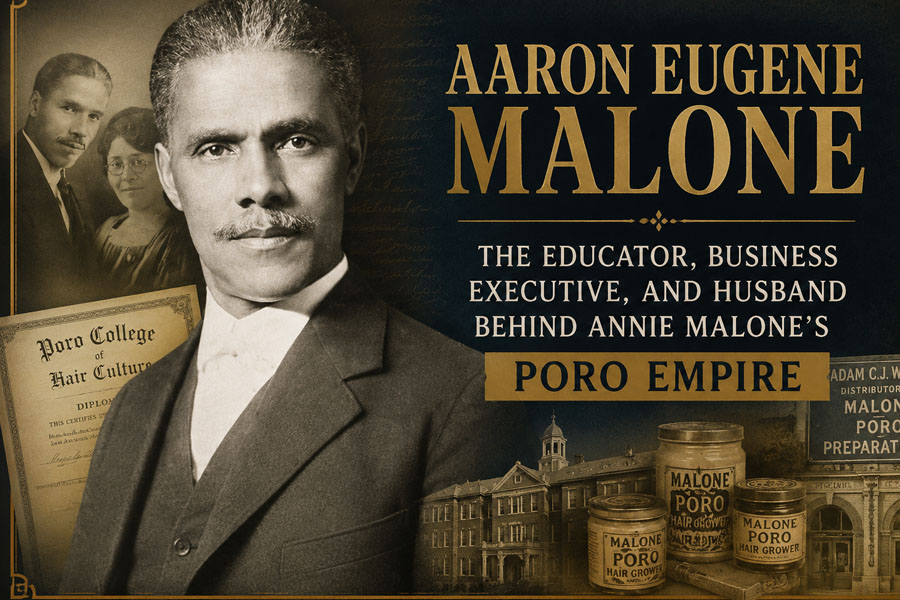
Aaron Eugene Malone occupies an unusual place in American business history. When I look at his life, I see a man whose story sits partly in the shadow of a much more famous spouse, yet his own career had several distinct chapters. He was an educator, school administrator, religious book salesman, community speaker, and eventually a major executive in one of the most important Black-owned beauty enterprises of the early twentieth century. A Washington University in St. Louis memorial identifies him as born November 10, 1865, and records his death on December 22, 1952. Other historical accounts give different birth years, so the precise year should be treated cautiously.
His most enduring public association came through Annie Minerva Turnbo Malone, the pioneering entrepreneur who founded the Poro beauty enterprise. Their marriage brought Aaron into the center of an expanding commercial organization that eventually became a major economic and educational institution for African American women.
Early Life and Education
The surviving record of Aaron Eugene Malone’s early life is comparatively thin. Historical accounts place his origins in Kentucky and describe him as a descendant of enslaved people. His family later moved to Metropolis, Illinois, where Aaron encountered Annie Turnbo, who would eventually become his wife. The two reportedly knew one another as young people before their paths diverged and later crossed again.
Education became an important part of Aaron’s early professional identity. He went to college, entered teaching, and eventually returned to Quincy, Illinois. In 1902, he became principal of the city’s Lincoln public school, an institution serving Black students. His position placed him among the African American educators helping build educational opportunity during an era when segregation severely restricted access to quality schooling.
I find this part of his biography particularly revealing because it shows that Aaron was not originally a businessman. His first professional language was the language of classrooms, administration, discipline, and public education.
Aaron Malone as an Educator and Community Leader
Aaron’s work in Quincy extended beyond the schoolhouse. Historical accounts describe him as active in the African Methodist Episcopal church and engaged in public discussions about racial advancement.
In December 1902, he delivered a lecture concerning what was described as the “Future Negro.” His speech reportedly addressed discriminatory laws in the South and emphasized education, economic development, and the importance of Black Americans becoming equipped to compete in American society. He referred to influential figures including Frederick Douglass and Booker T. Washington.
This public-speaking background would later prove useful in his business career. Aaron was accustomed to dealing with institutions, communities, and audiences. His later position at Poro required many of the same skills, although the classroom was replaced by corporate offices, training facilities, sales networks, and public events.
Marriage to Annie Malone
The defining personal relationship in Aaron Eugene Malone’s biography was his marriage to Annie Minerva Turnbo Malone.
Annie Malone had already established herself as an ambitious entrepreneur before their marriage. She developed hair-care products for African American women and built an increasingly sophisticated distribution network. By the time she married Aaron, her business had grown substantially and was moving toward the organization that became known as Poro.
Aaron and Annie married on April 28, 1914. Historical records describe Aaron as a former teacher and religious book salesman when they married. Annie subsequently brought him into her business, where he became president and chief manager.
Their marriage therefore became both a family relationship and a business partnership. Annie was the founder and entrepreneurial force behind Poro, while Aaron assumed substantial managerial responsibilities.
Family and Personal Relationships
Annie Minerva Turnbo Malone, Wife
Annie Malone was Aaron’s only clearly documented spouse and the central personal figure in his public biography.
Born Annie Minerva Turnbo, she became one of the most significant African American businesswomen of the early twentieth century. Her company manufactured and distributed hair-care and beauty products, while Poro College eventually became a training center and cultural institution.
Aaron’s role in her enterprise was substantial. He served as president and chief manager, while Annie remained the founder and central owner. A New York Public Library collection even preserves a 1922 Poro image specifically identifying “Aaron Eugene Malone; President.”
Their relationship eventually became deeply contentious. By the 1920s, disagreements over control of Poro had developed into a serious power struggle. In 1927, Aaron filed for divorce and sought a substantial share of the business. The dispute became a major public controversy and temporarily placed the company under court-related receivership.
The eventual settlement allowed Annie to retain control of Poro. Accounts commonly report that she agreed to a settlement of approximately $200,000. That figure is important in understanding the financial scale of their dispute, although it should not be interpreted as Aaron’s personal net worth.
Other Family Members
The surviving public record does not provide reliable, detailed information about Aaron Eugene Malone’s parents, siblings, or children. I would therefore avoid assigning names to relatives who cannot be securely connected to him.
Annie Malone herself is sometimes described as having had no children. Her later estate passed to nieces and nephews, but those relatives should not automatically be presented as Aaron’s biological family members.
This absence of information is significant. Aaron was a public educator and business executive, but historical documentation about his private family life remains surprisingly limited.
Aaron Malone and the Rise of Poro
Aaron’s greatest professional achievement was Poro leadership.
Poro expanded beyond cosmetics. Annie Malone turned it into a business, training system, employment network, and social institution. In the late 1910s, Poro College educated African American women hair care, beauty, professional conduct, presentation, and economic independence.
Aaron was president and CEO. His schooling and administration background explains the change. He went beyond supervising pupils and teachers. He oversaw a growing organization with agents, facilities, instructional initiatives, and commercial operations.
By the 1920s, Poro was a major economic force. One source says Poro College employed 175 individuals in 1926, but the Poro network employed tens of thousands of women as agents and representatives.
Aaron is named president in a 1922 Poro College leaflet saved by the New York Public Library, a rare visual and institutional documentation of his position.
Finance and Business Details
Aaron’s financial story is closely intertwined with Annie Malone’s wealth and Poro’s success.
The Malones were associated with a business empire that generated substantial wealth during the 1920s. One historical account records that the couple paid $38,408 in federal income taxes in 1923, illustrating the considerable scale of their finances at the time.
However, there is no dependable public figure establishing Aaron Eugene Malone’s personal net worth. Numbers sometimes attributed to the Malone household generally refer to Annie’s wealth or the value of the Poro enterprise rather than Aaron’s independently owned assets.
The most concrete financial figure associated directly with Aaron is the reported $200,000 divorce settlement he received after the 1927 dispute over Poro. Contemporary and later accounts describe his claim that his business contacts and managerial contributions helped create the company’s success. Annie ultimately retained the enterprise after the settlement.
The 1927 Divorce and Poro Power Struggle
The divorce transformed Aaron’s historical image.
For years, he had occupied a prestigious position inside Poro. By the middle of the 1920s, however, his relationship with Annie and the company had deteriorated. Historical accounts describe years of disagreement before Aaron sought divorce and argued that he deserved a major ownership interest in the business.
The case attracted attention within the Black press and African American community. Annie’s supporters included employees, community leaders, and prominent figures such as Mary McLeod Bethune. Eventually, Annie retained control of Poro.
I think this episode is the clearest example of how Aaron’s public legacy became inseparable from Annie’s. Without their marriage, he might be remembered primarily as a teacher and school principal. Because of their marriage, he became a central figure in one of the most consequential Black business disputes of the 1920s.
Later Years
After the divorce, Aaron largely disappeared from the public business narrative surrounding Poro. Annie continued operating the company and eventually moved its headquarters from St. Louis to Chicago in 1930.
Aaron’s later professional activities are less thoroughly documented. A Washington University memorial identifies him as having served as a professor at Poro College and records his death on December 22, 1952.
His final years therefore form something of a quiet epilogue. The enormous Poro enterprise that once made his name highly visible continued to evolve without him, while Annie’s later financial difficulties and eventual death in 1957 became the dominant chapters of the family’s historical story.
Aaron Eugene Malone died in 1952, so there are naturally no contemporary social media accounts or firsthand modern posts from him.
Modern references to his name are primarily historical. Museums, digital archives, Black history publications, and biographies of Annie Malone continue to mention him when discussing Poro and the 1914 to 1927 period. The New York Public Library’s digitized Poro collection is particularly notable because it preserves a historical image identifying him as the company’s president.
There are also modern articles and community-history projects revisiting his role as an educator and executive. These references tend to frame him not as an independent celebrity but as a supporting figure in the much larger story of Annie Malone and Black entrepreneurship.
Because the name “Aaron Eugene Malone” can also appear in unrelated modern records, those contemporary references should not automatically be attributed to the historical educator and Poro executive.
Extended Timeline of Aaron Eugene Malone
| Year | Event |
|---|---|
| 1860s | Aaron Eugene Malone is born. Washington University records November 10, 1865, while other accounts provide different years. |
| Childhood | His family is associated with Kentucky and later Metropolis, Illinois. |
| Early adulthood | Malone pursues higher education and enters the teaching profession. |
| 1902 | He becomes principal of Lincoln public school in Quincy, Illinois. |
| December 1902 | He delivers a public lecture addressing Black education, racial inequality, and social advancement. |
| 1900s | He works as an educator and is active in the African Methodist Episcopal church. |
| April 28, 1914 | He marries Annie Minerva Turnbo Malone. |
| 1910s | He becomes increasingly involved in Annie Malone’s growing Poro enterprise. |
| 1918 | Poro College emerges as a major beauty-training and educational institution. |
| 1920s | Aaron serves as Poro’s president and chief manager as the enterprise expands. |
| 1922 | A Poro College publication identifies him as president. |
| 1923 | The Malones are associated with a federal income-tax payment of $38,408. |
| 1926 | Poro College is reported to have about 175 employees, with a much larger international agent network. |
| 1927 | Aaron and Annie’s marriage ends in a highly publicized divorce and business dispute. |
| 1927 | Aaron seeks a substantial share of Poro; Annie ultimately retains control after a reported $200,000 settlement. |
| 1930s | Aaron becomes far less visible in public accounts of Poro. |
| December 22, 1952 | Aaron Eugene Malone dies in St. Louis. |
Aaron Eugene Malone’s Historical Significance
Most notable about Aaron Eugene Malone’s story is his transition between education, community leadership, and entrepreneurship.
He became a teacher and principal when Black educators were creating schools under harsh limitations. Religious bookselling and public speaking followed before he became president of a pioneering Black cosmetics company. His administrative work at Poro led him to a company that employed hundreds of African American women.
His public life was defined by his marriage to Annie Malone. Their relationship grew Poro, but their fight over control was equally memorable.
Aaron’s story goes beyond him being a famous businessman’s husband. A teacher became an executive in the rising Black commercial world. He may be less well-known than Annie Malone, but he was Poro’s president and manager for over a decade, running a beauty firm, school, employment network, and community institution.
FAQ
Who was Aaron Eugene Malone?
Aaron Eugene Malone was an American educator, school principal, religious book salesman, and business executive who became president and chief manager of Annie Malone’s Poro enterprise.
When did Aaron Eugene Malone marry Annie Malone?
Aaron Eugene Malone married Annie Minerva Turnbo Malone on April 28, 1914.
What was Aaron Malone’s role at Poro?
He served as president and chief manager of Poro, overseeing business and administrative responsibilities while Annie Malone remained the company’s founder and central entrepreneurial figure.
When did Aaron Eugene Malone and Annie Malone divorce?
The couple divorced in 1927 after a major dispute involving their marriage and control of the Poro business.
Did Aaron Eugene Malone have children?
Reliable historical records do not establish that Aaron Eugene Malone had children. Annie Malone herself is generally documented as having no children.
How much money did Aaron Eugene Malone receive from the divorce?
Historical accounts commonly report a settlement of approximately $200,000 for Aaron following the 1927 dispute, although the exact financial terms are presented differently in various accounts.
What was Aaron Eugene Malone’s net worth?
There is no reliable historical record establishing Aaron Eugene Malone’s personal net worth. Financial figures associated with the Malones generally concern Annie Malone or the Poro enterprise rather than Aaron’s separate wealth.
When did Aaron Eugene Malone die?
Aaron Eugene Malone died on December 22, 1952, in St. Louis, Missouri.
What is Aaron Eugene Malone best remembered for?
He is best remembered for serving as president of Poro and for his marriage and subsequent business dispute with Annie Malone, although his earlier career as an educator and principal was also significant.