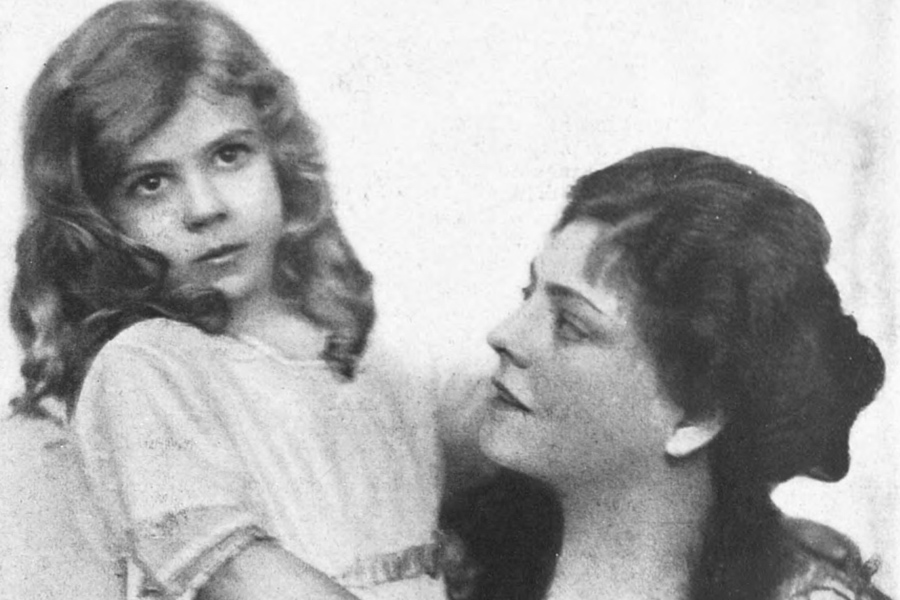
A Daughter Born into Two Great American Lineages
I think of Ethel Barrymore Colt as a woman who was born beneath a bright and unforgiving spotlight. She arrived in 1912 in Mamaroneck, New York, carrying two heavy inheritances at once. On one side stood the Barrymores, the celebrated acting family whose names seemed to ring through American theater like church bells. On the other stood the Colts, a Rhode Island family tied to wealth, power, and industry. That combination was not a soft cradle. It was more like being placed on a narrow bridge over deep water and asked to walk gracefully.
Her mother, Ethel Barrymore, was already a force of nature, a stage legend whose reputation towered over the American theater. Her father, Russell Griswold Colt, came from the influential Colt family. Her grandparents and great-grandparents formed a dense web of famous names: Maurice Barrymore and Georgiana Drew Barrymore on one side, Samuel Pomeroy Colt and Elizabeth Bullock on the other, with older roots reaching back to John Drew Sr., Louisa Lane Drew, and William Edward Blythe. Family, for Ethel Barrymore Colt, was not a small circle. It was an entire forest of inherited history.
The Weight and Warmth of Family
I find the family story fascinating because it is both grand and intimate. Ethel Barrymore Colt had brothers, including Samuel Colt and John Drew Colt, and each member of the family seemed to carry a different shard of the same bright inheritance. John Drew Colt and Samuel Colt moved in the orbit of performance and public life, just as she did. Her mother’s fame and her father’s lineage made privacy difficult, but they also created a world in which talent could be expected, tested, and displayed.
Her marriage to John Romeo Miglietta in 1944 gave her a personal anchor outside the old family names. He was a New York businessman, and their union offered a quieter kind of stability. They had one son, John Drew Miglietta, born in 1946. I see that family as a braided rope, made stronger by different strands, even when the tension was high. Her husband’s life and her son’s birth added a human scale to a story often dominated by fame and legacy.
There is also something revealing in the way she related to Linden Place in Bristol, Rhode Island. The house itself became a kind of family manuscript written in wood, stone, and memory. She inherited part ownership in 1960, and that inheritance was not only financial. It was emotional, historical, almost ceremonial. The mansion was a living reminder that family can be a home, a burden, and a stage all at once.
A Career Built in the Shadow of Fame
Ethel Barrymore Colt lived outside her family name. She tried to stand out. That distinction counts. Scarlet Sister Mary, beside her mother, was her Broadway debut in 1930. That moment may have been decorative, a daughter in the family frame. It was the start of a longer performance.
Stage, song, and leadership were her career. She appeared on Broadway in George White’s Scandals, Under Glass, L’Aiglon, London Assurance, Orchids Preferred, Whiteoaks, Martha, and Follies. She added to her artistic personality by writing London Assurance lyrics. Her talents went beyond performance. She made.
Her Jitney Players work impresses me. She didn’t just face the audience. She drove the truck, sewed costumes, wrote, and oversaw the troupe after bankruptcy. That work is the arts’ hidden scaffolding. It sparkles less than applause, but the theater crumbles without it. She lived both sides of the curtain, which gave her a deeper stage comprehension than most performers.
She became a successful singer. She sang lyric soprano in concerts, nightclubs, opera companies, and one-woman shows, according to reports and family histories. She sang in the New York City Opera, toured, and delivered over 100 US and international engagements. Die Fledermaus aired on NBC in 1950. Follies’ initial firm hired her in 1971. One of her secret accomplishments is her decades-long career.
Achievement, Reinvention, and Public Identity
Ethel Barrymore Colt’s greatest achievement may have been her ability to keep reinventing herself without breaking the thread of who she was. Many children of famous parents either flee the family shadow or drown in it. She did neither. She tested the shadow, shaped it, and turned it into a working space.
At times she used the name Louisa Kinlock, trying to be heard as a singer before being heard as a descendant. That choice says a great deal. It suggests ambition, but also vulnerability. She knew the family name could open doors, yet it could also close minds. People might come to see Ethel Barrymore’s daughter, not Ethel Barrymore Colt. So she sought room to breathe.
She also taught voice lessons, including in the back parlor of Linden Place. That detail matters to me because it makes her feel lived in, not merely historical. A voice teacher’s room is usually filled with scales, repetition, patience, and small triumphs. It is the opposite of empty celebrity. Her life was not all glitter. It had discipline, routine, and service.
The Barrymore and Colt Legacy in One Person
If I step back, Ethel Barrymore Colt connects dynasties. She inherited the Barrymores’ drama and the Colts’ weight. Maurice and Georgiana Drew Barrymore, her maternal grandparents, were part of America’s most famous stage family. Samuel Pomeroy Colt and Elizabeth Bullock, her paternal grandparents, linked her to finance, industry, and Rhode Island importance. Through John Drew Sr., Louisa Lane Drew, and William Edward Blythe, her great-grandparents extend into elder theater.
Ancestry might feel like armor or a cloak that never fits. She wore it gracefully and determinedly. She sang, acted, taught, managed, inherited, conserved. She performed and remembered.
Ethel Barrymore Colt in Dates and Milestones
| Year | Milestone |
|---|---|
| 1912 | Born in Mamaroneck, New York |
| 1930 | Broadway debut in Scarlet Sister Mary |
| 1931 | Appeared in George White’s Scandals |
| 1937 | Performed in London Assurance and wrote lyrics |
| 1944 | Married John Romeo Miglietta |
| 1946 | Son John Drew Miglietta was born |
| 1950 | Appeared in televised Die Fledermaus |
| 1960 | Inherited one quarter of Linden Place |
| 1971 | Appeared in Follies |
| 1973 | Recorded O rare Ben Jonson! |
| 1977 | Died in New York City |
FAQ
Who was Ethel Barrymore Colt?
Ethel Barrymore Colt was an American actress, singer, lyric soprano, teacher, and theatrical worker born in 1912. I see her as a woman shaped by extraordinary ancestry but determined to build a real career of her own. She performed on Broadway, sang in concerts and operas, worked with the Jitney Players, and stayed tied to the cultural life of her family home in Rhode Island.
Who were her parents?
Her mother was the legendary actress Ethel Barrymore, and her father was Russell Griswold Colt. That pairing joined two very different worlds. One was the theatrical empire of the Barrymores. The other was the industrial and financial strength of the Colts. Together, they placed her at the meeting point of stage light and family power.
Did she have siblings?
Yes. Her family included brothers John Drew Colt and Samuel Colt. They were also connected to performance and public life, continuing the family pattern in different ways. In a family like this, even siblings seem to arrive as variations on the same old melody.
Who did she marry and did she have children?
She married John Romeo Miglietta in 1944. They had one son, John Drew Miglietta, born in 1946. Her marriage appears to have been a steady part of her adult life, and her son added another generation to a family already thick with history.
What was she best known for?
She was best known for her stage work, her singing, and her ability to keep working in many forms. She made her Broadway debut in 1930, appeared in several productions over the years, sang with opera companies, performed in concerts, and even managed the Jitney Players. Her career was less a straight line than a river branching through many landscapes.
What is Linden Place’s importance in her life?
Linden Place was a major family property in Bristol, Rhode Island, and she inherited part ownership in 1960. It was more than a house. It was a family landmark, a symbol of legacy, and later a place linked to her teaching and cultural work. For her, it seems to have functioned like a memory palace made real in brick and mortar.
Why does her life still matter?
Her life matters because it shows how a person can inherit fame without becoming hollowed out by it. She did not simply carry a famous name. She worked, learned, taught, sang, managed, and performed. I think of her as someone who turned legacy into labor, and labor into art.